
As organizations increasingly prioritize security, efficiency, and hygiene, traditional access methods such as keycards or manual checks are becoming outdated. A biometric turnstile gate with face and fingerprint recognition provides a modern, secure, and contactless solution for access control and workforce management.
By combining facial recognition and fingerprint authentication, this system ensures highly accurate identification while streamlining the flow of people in high-traffic environments. In this article, we explore its technology, benefits, applications, and why it is becoming the standard for modern facilities.
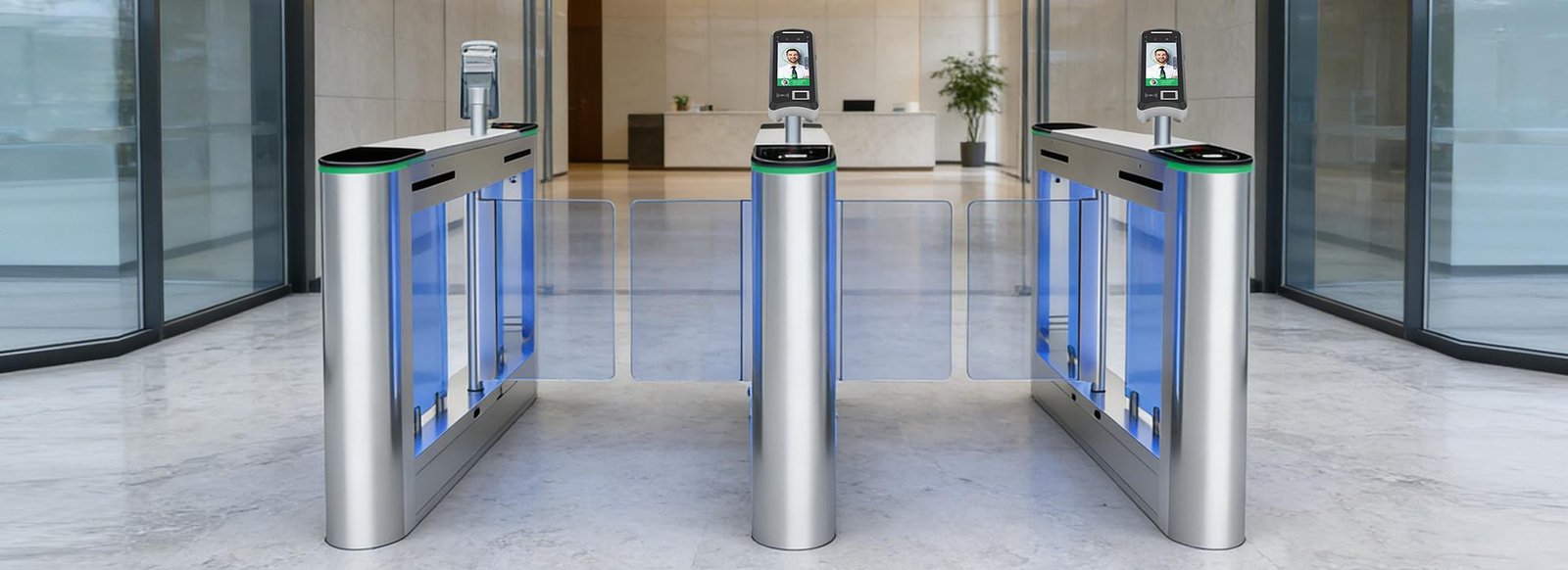
What Is a Biometric Turnstile Gate?
A biometric turnstile gate is an access control device that integrates a physical turnstile with biometric authentication technologies. It ensures that only authorized personnel can pass through while maintaining an organized flow.
Key components include:
Turnstile barrier: Regulates entry and exit for single users at a time.
Facial recognition module: Captures facial features and matches against a secure database.
Fingerprint scanner: Reads fingerprints as a secondary or alternative authentication method.
Access control software: Integrates with attendance systems, visitor management, and security platforms.
By combining multiple authentication methods, this gate offers enhanced security, accuracy, and versatility for diverse applications.
How Face and Fingerprint Recognition Work
1. Facial Recognition
Uses AI-powered cameras to capture facial features.
Compares live images against stored templates.
Can detect liveness to prevent spoofing using photos or videos.
Provides contactless authentication, reducing hygiene concerns.
2. Fingerprint Recognition
Scans the unique ridge patterns of an individual’s finger.
Uses capacitive, optical, or ultrasonic sensors for precise readings.
Matches scanned fingerprints against registered templates in milliseconds.
Can be used as a primary authentication or secondary verification.
By combining these two modalities, the turnstile gate can offer multi-factor authentication, improving accuracy and reducing false access attempts.
Benefits of a Biometric Turnstile Gate with Face and Fingerprint Recognition
1. Enhanced Security
Multi-factor authentication ensures only authorized personnel enter.
Anti-spoofing algorithms prevent fake face or fingerprint attempts.
Digital logs record each entry and exit, improving audit trails.
2. Contactless and Hygienic
Facial recognition allows users to pass without physical contact.
Reduces transmission risk in high-traffic or healthcare environments.
3. High Accuracy and Speed
Facial and fingerprint recognition systems both achieve low false acceptance rates (FAR) and low false rejection rates (FRR).
Capable of handling high volumes of users per hour, ideal for offices, factories, airports, and public facilities.
4. Efficient Workforce and Visitor Management
Integrates with time and attendance systems for automatic employee tracking.
Can manage visitor authentication with temporary access credentials.
Simplifies payroll and security reporting through digital records.
5. Flexible and Scalable
Supports multiple credential types, including card readers, QR codes, or mobile apps.
Easily expandable for large enterprises or high-traffic public facilities.
Compatible with central management software for multi-site deployment.
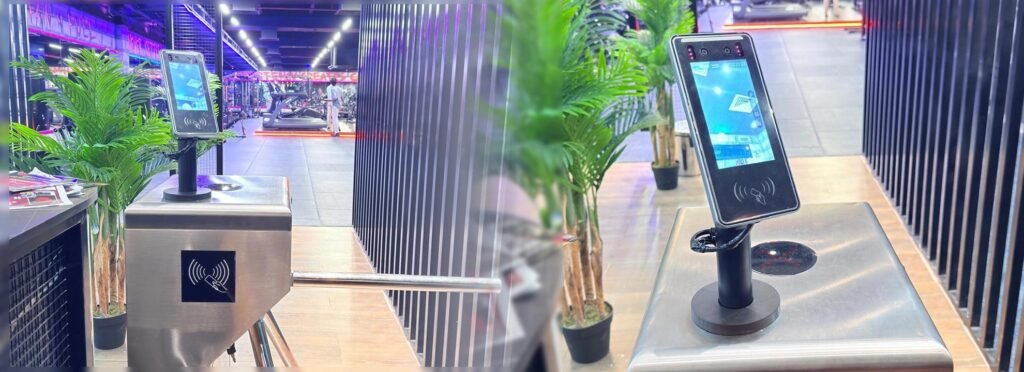
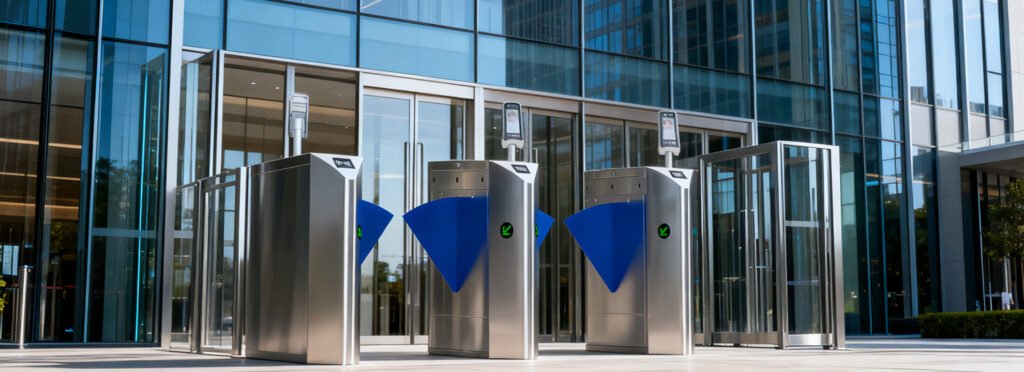
Applications of Biometric Turnstile Gates
Corporate Offices: Secure entry and automated attendance tracking.
Factories and Industrial Sites: Control access to hazardous or restricted areas.
Government Buildings: High-level security with audit logs.
Airports and Transportation Hubs: Fast, accurate passenger identification.
Healthcare Facilities: Hygienic, contactless verification for staff and visitors.
Banks and Financial Institutions: Protect sensitive areas while ensuring smooth entry.
Why Combine Face and Fingerprint Recognition?
Using both facial recognition and fingerprint authentication offers several advantages:
Redundancy: If one method fails, the other can ensure access.
Higher security: Multi-factor authentication reduces the risk of unauthorized access.
User flexibility: Employees or visitors can use their preferred biometric method.
Enhanced accuracy: Combining modalities lowers false acceptance and rejection rates.
Installation and Integration Considerations
Ensure optimal camera placement for facial recognition.
Proper finger placement guidelines for accurate fingerprint scans.
Integration with attendance, HR, and security software for full functionality.
Regular maintenance and firmware updates to sustain system reliability.
Modern systems also support remote management, allowing administrators to control access and monitor activity from centralized dashboards.
Future Trends
AI-powered multi-biometric systems: Combining palm vein, iris, face, and fingerprint recognition for ultra-secure environments.
Cloud-based attendance management: Centralized monitoring, reporting, and analytics.
Faster processing speeds: Improved AI algorithms reduce authentication time.
Enhanced liveness detection: Prevent spoofing with advanced infrared and 3D scanning.
Conclusion
A biometric turnstile gate with face and fingerprint recognition is a modern solution that combines security, efficiency, and hygiene. It is ideal for enterprises, industrial facilities, public areas, and high-security buildings.
By leveraging multi-factor biometric authentication, organizations can ensure only authorized personnel gain access, simplify workforce management, and maintain smooth user flow even in high-traffic environments.
Investing in a biometric turnstile gate is a future-proof strategy for organizations seeking high security, accurate attendance tracking, and scalable access management.
FAQ
What is a biometric turnstile gate?
A biometric turnstile gate is an access control system that uses biometric authentication (like face or fingerprint recognition) integrated with a physical turnstile barrier to control entry and exit.
How does combining face and fingerprint recognition improve security?
Using two biometric methods ensures multi-factor authentication, reducing the risk of unauthorized access. If one method fails or is spoofed, the other serves as a backup.
Can this system integrate with attendance management software?
Yes. Most biometric turnstile gates can connect to time and attendance software, allowing automated employee tracking and reporting.
Is face recognition safer than fingerprint recognition?
Both are secure. Face recognition offers contactless authentication, while fingerprint recognition is highly reliable and cost-effective. Combining both provides maximum accuracy and security.
Where are biometric turnstile gates commonly used?
Offices and corporate buildings
Factories and industrial sites
Airports and transportation hubs
Banks and financial institutions
Hospitals and healthcare facilities
How fast can users pass through the turnstile gate?
Modern biometric turnstile gates authenticate users in 1–2 seconds, making them suitable for high-traffic areas without causing delays.